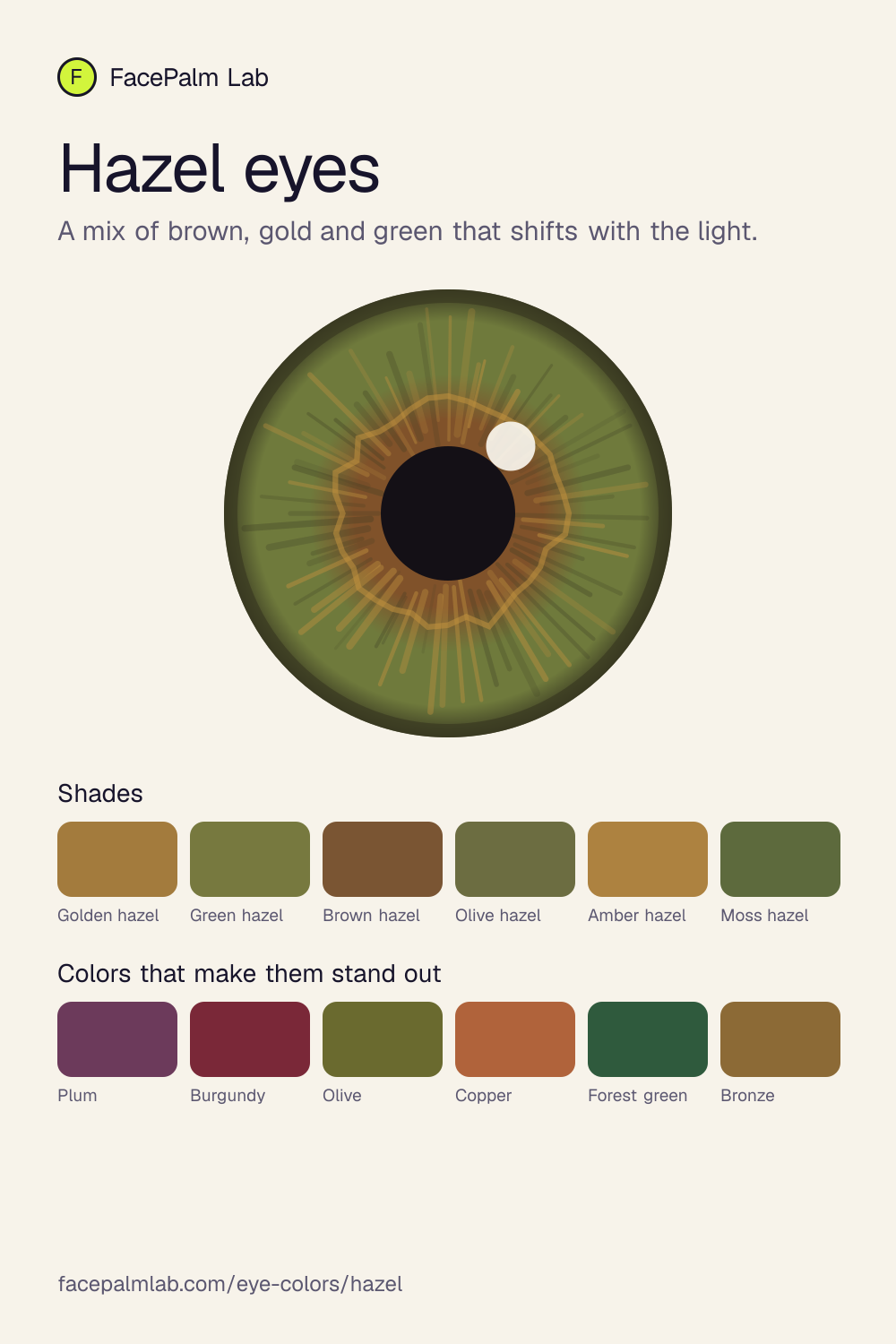
Hazel is the eye color people argue about most. Ask three friends what color hazel eyes are and you will get three answers, brown, green and gold, and all of them are partly right. That is because hazel is a blend rather than one color, and the blend shifts with the light.
What hazel eyes look like
Most hazel eyes have two zones. The inner zone, around the pupil, is light brown, honey or gold. The outer zone is green, olive or khaki. Between them there is often a wavy ring where the two colors meet, and many hazel eyes have small gold or brown flecks scattered through the green.
No two hazel eyes share the same balance. Some are mostly green with a thin golden ring. Others are mostly brown with a hint of green at the edge. That range is why the same person can be called brown eyed by one friend and green eyed by another.
Hazel green eyes
Hazel green eyes sit at the green end of the hazel range. The outer part of the iris is clearly green, and the brown or gold is limited to a ring around the pupil. They are often mistaken for green eyes, and the difference is mostly a matter of how much warm color is in the center. If the gold ring covers more than a thin band around the pupil, most people would call the eyes hazel.
A clearly different ring around the pupil is also known as central heterochromia, which our guide to central heterochromia explains. Many hazel eyes have exactly this pattern, so the two terms overlap.
Hazel vs brown eyes
The quickest way to tell hazel from brown eyes is to look in daylight, close to a window, with a mirror.
- Brown eyes are brown all the way to the edge of the iris. Light brown eyes can show gold in sun, but not green.
- Hazel eyes show green, olive or gray green somewhere in the iris, usually in the outer part.
Indoor light is warm and dim, which hides green and makes hazel eyes read as brown. So if your eyes look brown at home and greenish outside, you most likely have hazel eyes. Our eye color checker reads both zones separately and tells you how much of each color it found.
How common are hazel eyes
In a 2014 poll of more than 2,000 US adults for the American Academy of Ophthalmology, about 18 percent said they have hazel eyes, behind brown and blue. Hazel is less common worldwide, where brown is by far the most common color. Self reported numbers are rough, because many people with hazel eyes describe them as brown or green. Our guide to the rarest eye colors compares every color.
Why hazel eyes look the way they do
There is no green pigment in the human eye. Every eye color comes from two things, the amount of melanin in the front layer of the iris and the way light scatters in that layer.
- Melanin, the same dark pigment found in skin and hair, absorbs light and looks brown. Brown eyes have a lot of it.
- Scattering happens when light bounces off the fine fibers of the iris. Short, blue wavelengths scatter most, which is why eyes with very little melanin look blue.
- Hazel eyes have a moderate amount of melanin, often more around the pupil than at the edge. The brown pigment near the center reads as brown or gold, while the thinner pigment further out mixes with scattered light and reads as green.
Because the color depends on scattered light, hazel eyes respond to their surroundings more than brown eyes do. Our article on the eye color chart shows where hazel sits between brown and green.
Why hazel eyes seem to change color
Hazel eyes are famous for changing color, but the iris does not change from hour to hour. What changes is the light and what is around you.
- Daylight shows the most green. Warm lamps push hazel toward brown and gold.
- Clothes and makeup reflect color onto the eye and change what the brain expects to see. Green and olive tops pull out the green, while browns and golds pull out the warm center.
- Pupil size changes how much of the golden inner ring shows. In bright light the pupil is small and the inner ring looks wider.
A slow change over the first year or two of life is normal, because many babies start with lighter eyes that darken. In adults, a new change in eye color that does not come and go with the light is worth showing to an eye doctor.
Makeup and clothes for hazel eyes
The simplest rule is to choose colors that sit across the color wheel from the shade you want to bring out. Purple, plum and wine sit opposite green, so they make the green in hazel eyes look stronger. Copper, bronze and warm brown echo the gold center and make it glow. Olive and forest green repeat the green and make it look richer.
For the colors that suit your skin and hair as well as your eyes, try our seasonal color analysis. It reads your whole coloring and gives you a palette of 24 colors.
Hazel, green and brown compared
| Brown | Hazel | Green | |
|---|---|---|---|
| Pigment | Plenty | Moderate, more near the pupil | Little, with a yellow tint |
| Near the pupil | Brown | Brown or gold | Often a thin gold ring |
| Outer iris | Brown | Green or olive | Green |
| In warm light | Stays brown | Looks more brown | Looks more olive |
If your result from our checker sits between two colors, read both guides. The line between them is not sharp, and many eyes sit right on it.