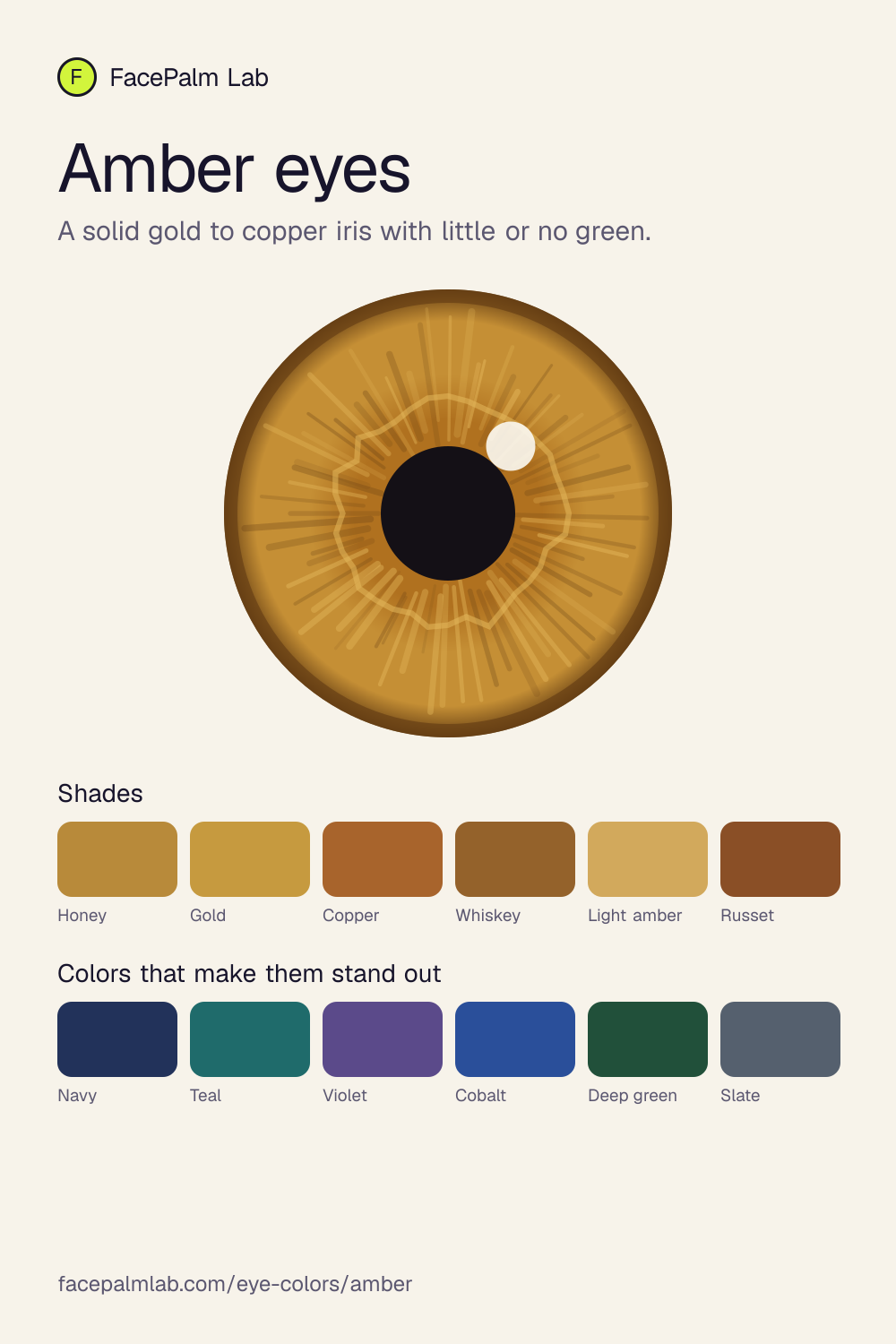
Amber eyes have a glow that photographs well and is hard to describe. People call them gold, honey, whiskey, copper or wolf eyes. Whatever the name, the defining trait is the same, an even warm color across the whole iris with little or no green and no clear brown center.
What amber eyes look like
Amber eyes range from pale gold and honey to deep copper and russet. The color tends to be even from the pupil to the edge, which is what sets amber apart from hazel. Many amber eyes have a darker limbal ring at the edge of the iris, which makes the gold look brighter by contrast.
In sunlight amber eyes can look almost yellow or orange. Indoors they settle into a warm light brown. That shift is a big reason amber eyes are so often called light brown.
How amber eyes get their color
Every eye color depends on the pigment in the front layer of the iris. Brown eyes have a lot of melanin, the dark brown pigment. Amber eyes seem to have a moderate amount, along with a yellowish pigment often called lipochrome, which is also thought to give green eyes their warmth.
With little scattering of blue light and plenty of yellow tone, the iris reads as gold rather than green or brown. The exact chemistry of iris pigment is still studied, and researchers describe eye color as shaped by many genes rather than one. Our guide to eye color genetics covers what is known.
How rare are amber eyes
There is no solid count for amber eyes. Most surveys ask people to choose from brown, blue, hazel and green, so amber is counted inside brown or hazel. In a 2014 poll of US adults for the American Academy of Ophthalmology, only about 1 percent chose a color other than those four. Amber is often listed among the less common eye colors, and our guide to the rarest eye colors explains why every rarity ranking should be read loosely.
Amber vs hazel eyes
Amber and hazel eyes are the most common mix up.
- Amber eyes are one even golden color. There is little or no green anywhere in the iris.
- Hazel eyes mix gold or brown with green, usually with green toward the edge.
Check in daylight, close to a window, with a mirror. If you see green anywhere, the eyes are most likely hazel. If the iris is one warm, even color, it is amber.
Amber vs light brown eyes
The line between amber and brown eyes at the light end is blurry. Light brown eyes look brown first, with golden flecks or a golden glow in sun. Amber eyes look golden first, sometimes with a coppery edge. Under warm indoor light the two can look the same, so daylight is the best judge.
Our eye color checker sorts every pixel of your iris into color families and shows how much of each it found. A strong amber share with little brown and no green reads as amber. A mix of brown and gold reads as light brown.
Why amber eyes seem to change color
Amber eyes respond strongly to light. Sunlight makes them glow gold, shade turns them a softer brown, and warm lamps push them toward copper. Clothes near the face matter too. Blue and purple tops make amber eyes look brighter, while browns and oranges blend with them.
The pigment itself stays the same. In adults, a new change in eye color that does not come and go with the light is worth showing to an eye doctor.
Makeup and clothes for amber eyes
Blue and purple sit across the color wheel from gold, so they make amber eyes stand out.
- Liners and shadows. Navy, deep violet, plum and teal liners make the gold look brighter. Soft bronze and warm brown shadows keep the look warm and natural.
- Clothes. Navy, cobalt, teal and deep green are especially flattering. Slate and charcoal make a calm, cool frame.
- Jewelry. Gold echoes the eyes, while silver adds contrast.
For a full palette built around your skin and hair as well as your eyes, try our seasonal color analysis.
Amber eyes at a glance
| Trait | Amber eyes |
|---|---|
| Look | Even gold to copper, little or no green |
| Pigment | Moderate melanin with a yellow tint |
| Most often confused with | Hazel and light brown |
| Looks brightest in | Sunlight, next to navy, violet or teal |
| How common | Uncommon, rarely counted on its own |