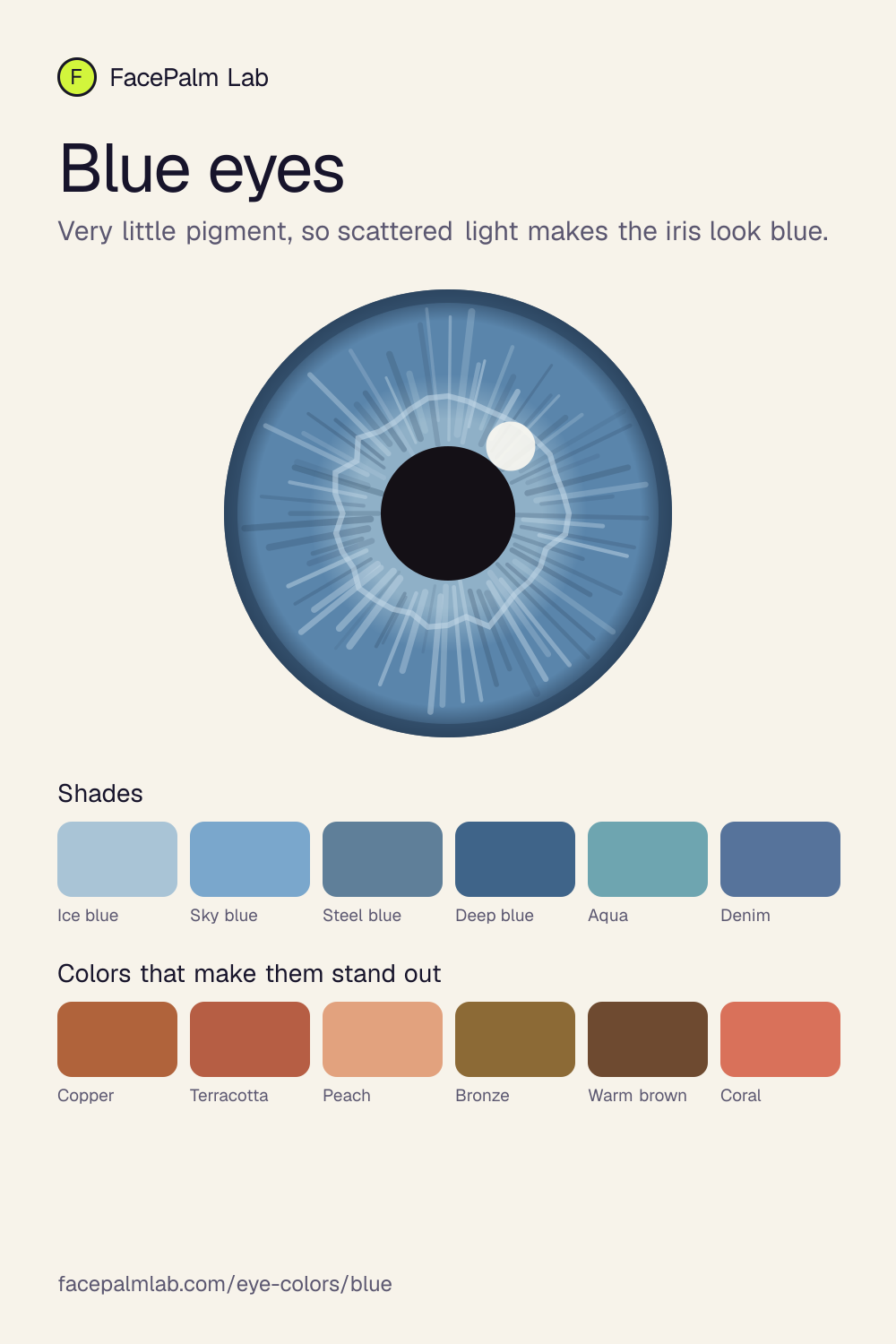
Blue eyes are a trick of the light in the most literal sense. There is no blue pigment anywhere in a blue eye. The color comes from light scattering in an iris that holds very little pigment, which is also why blue eyes can look gray one day and bright sky blue the next.
What blue eyes look like
Blue eyes range from pale ice blue and sky blue to deep steel and denim blue. Many have a darker ring at the outer edge, called a limbal ring, and some have fine white or gray fibers that radiate out from the pupil. A few blue eyes have a small gold or brown ring around the pupil, a pattern called central heterochromia.
Why blue eyes look blue
The iris has two main layers. The back layer is dark in almost everyone. The front layer, called the stroma, holds a varying amount of melanin, the brown pigment.
- Very little melanin. In blue eyes, the stroma holds almost no pigment, so light passes into it rather than being absorbed.
- Scattering. The fine fibers of the stroma scatter short blue wavelengths back out more strongly than longer red ones.
- A dark backdrop. The dark back layer absorbs the rest, so the scattered blue is what we see.
This is the same kind of effect that makes the sky blue. Because the color depends on light rather than pigment, blue eyes respond strongly to their surroundings.
Most blue eyed people share one small change in the DNA that turns down a gene called OCA2, which helps make melanin. That change was described in a 2008 study and is the strongest single genetic link to blue eyes, though other genes also shape the shade. Our guide to eye color genetics explains how this works.
How common are blue eyes
In a 2014 poll of more than 2,000 US adults for the American Academy of Ophthalmology, about 27 percent said their eyes are blue. That makes blue the second most common color in the US, after brown. Worldwide, blue is much less common, at around 8 to 10 percent of people. Our guide to the rarest eye colors compares every color.
Blue vs gray eyes
Gray eyes are close cousins of blue eyes. Both have very little pigment. The difference is thought to be in the structure of the stroma. Gray eyes seem to have more collagen, which scatters all colors of light more evenly, so the eye looks silver or gray rather than clearly blue.
In practice the two overlap a lot. Steel blue and blue gray eyes sit right between them, and the same eyes can look blue in sunlight and gray under a cloudy sky.
Blue vs green eyes
Some blue eyes carry a little yellow tint, which turns the scattered blue toward teal or aqua. With a bit more yellow and a little more brown pigment, the eyes read as green eyes. Eyes in between are often called blue green, which our guide to blue green eyes covers in full.
Why blue eyes seem to change color
The pigment in an adult blue eye stays the same, but what you see changes all the time.
- Light. Bright daylight makes blue eyes look vivid. Overcast light and shade make them look gray or steely.
- Clothes. Blue clothing reflects onto the eye and deepens the blue. Gray clothing makes the eye look gray.
- Pupil size. In dim light the pupil grows, the visible iris shrinks and the eyes look darker.
Many babies have blue eyes at birth that darken over the first year or two as pigment builds up. In adults, a new change in eye color that does not come and go with the light is worth showing to an eye doctor.
Makeup and clothes for blue eyes
Orange sits across the color wheel from blue, so warm shades make blue eyes look brighter.
- Shadows. Copper, bronze, peach and terracotta make blue eyes stand out. Warm brown is a softer everyday choice.
- Liner. Brown liner looks softer than black and lets the blue show.
- Clothes. Coral, rust and camel make the eyes pop by contrast. Navy and denim make them look deeper.
For a palette that suits your skin and hair as well as your eyes, try our seasonal color analysis. To check whether your eyes read as blue, gray or blue green, try our eye color checker.
Blue eyes at a glance
| Trait | Blue eyes |
|---|---|
| Pigment | Very little melanin in the front layer |
| Common shades | Ice, sky, steel, deep blue, aqua |
| Most often confused with | Gray and green |
| Looks brightest in | Sunlight, next to copper, coral or peach |
| How common | About 27 percent in the US, 8 to 10 percent worldwide |