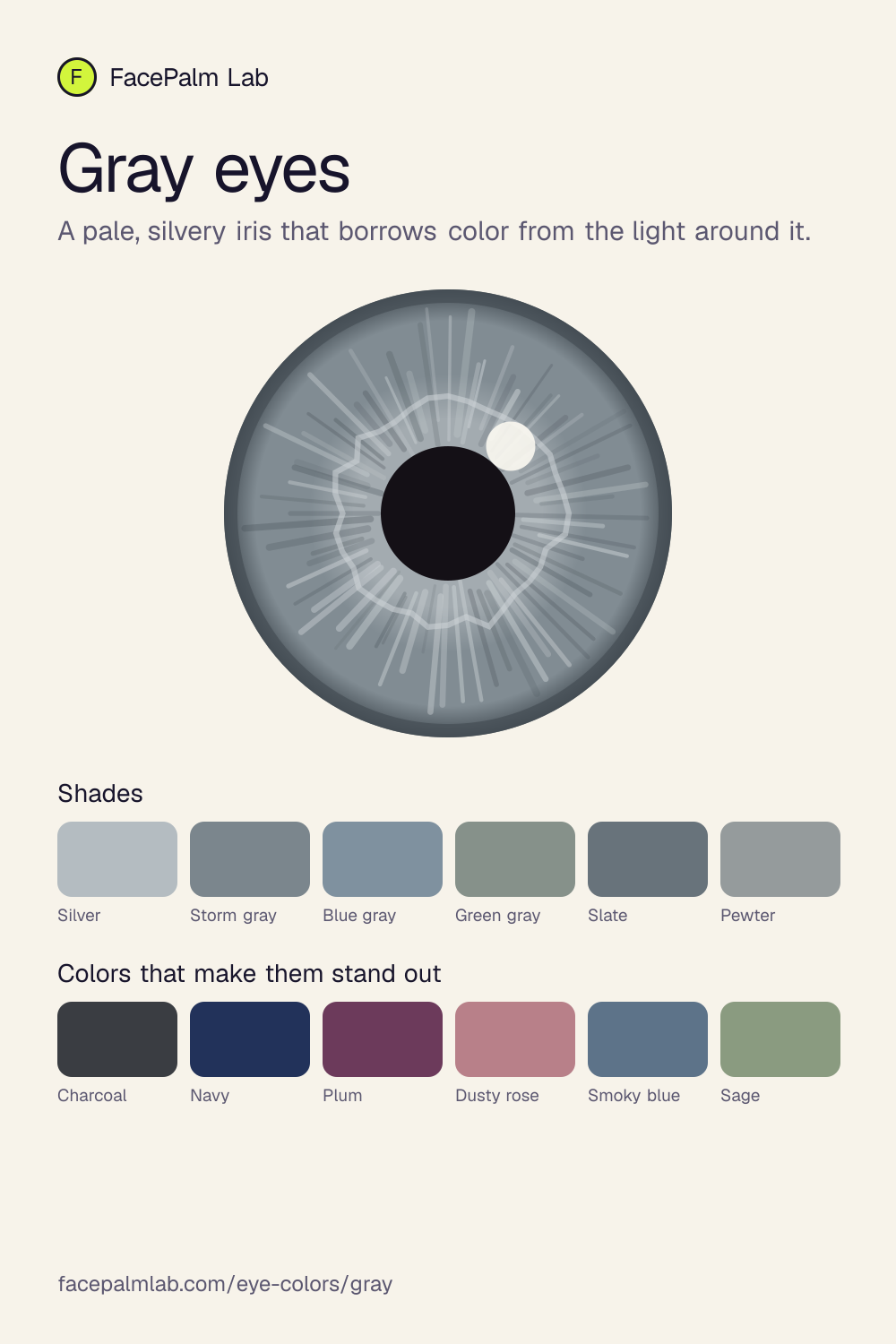
Gray eyes have a quality that photographs rarely capture. In one light they look silver, in another blue, and next to a green sweater they look almost green. That is not imagination. Gray eyes have so little color of their own that they pick it up from everything around them.
What gray eyes look like
Gray eyes range from pale silver and pewter to deep slate and storm gray. Many have a darker limbal ring at the edge and a few gold or brown flecks near the pupil. Some lean toward blue and are called blue gray, while others lean toward green and are called gray green.
Why gray eyes look gray
Like blue eyes, gray eyes have very little melanin in the front layer of the iris, the stroma. Without pigment to absorb it, light enters the stroma and scatters back out.
The difference is thought to be in how much collagen the stroma holds. In blue eyes, the fine fibers scatter mostly short blue wavelengths. In gray eyes, larger collagen deposits are thought to scatter all wavelengths more evenly, so the light that comes back is closer to white, and the eye reads as gray or silver. The exact structure is still studied, but the result is clear in everyday life. Gray eyes are less blue and more changeable than blue eyes.
How rare are gray eyes
Gray eyes are often listed among the rarest natural eye colors, but there is no reliable count. Most surveys ask people to choose between brown, blue, hazel and green, so gray is folded into blue. In a 2014 poll of US adults for the American Academy of Ophthalmology, only about 1 percent chose a color outside those four. Our guide to the rarest eye colors explains why every rarity ranking is an estimate.
Gray vs blue eyes
The line between gray and blue eyes is the hardest one to draw. Both have very little pigment, and the same eyes can look blue in sun and gray under clouds.
- Blue eyes look clearly blue in most daylight.
- Gray eyes look silver, pewter or slate in most daylight, and only look blue next to blue.
- Blue gray eyes sit in between, a cool steely shade.
Our eye color checker reads every pixel of the iris and tells you whether it found mostly blue, mostly gray or a mix of both.
Gray vs green eyes
Some gray eyes carry a light yellow tint, which pulls them toward green eyes. The result is often called gray green, a muted sage shade. Next to green or olive clothing these eyes can look clearly green, and next to gray they look silver.
Why gray eyes seem to change color
Gray eyes are the most changeable of all eye colors, because they reflect their surroundings so strongly.
- Clothes and makeup near the face lend their color to the eye. Navy pulls out blue, sage pulls out green and charcoal makes the eye look silver.
- Light matters too. Overcast light looks cool and silvery, warm lamps add a hint of green or gold.
- Pupil size changes how much iris shows, so the eyes look darker in dim light.
The pigment stays the same. In adults, a new change in eye color that does not come and go with the light is worth showing to an eye doctor.
Makeup and clothes for gray eyes
Gray eyes give you a choice. Decide which tone you want to bring out, then pick colors to match.
- To look silver. Charcoal, smoky gray and black liner make gray eyes look bright and metallic.
- To look blue. Navy, smoky blue and denim reflect blue into the eye.
- To look green. Sage, olive and khaki pull out any green.
- For warmth. Plum, mauve and dusty rose add a soft contrast without overwhelming the eyes.
For a palette built around your skin and hair as well as your eyes, try our seasonal color analysis. Our eye color chart shows where gray sits among every other shade.
Gray eyes at a glance
| Trait | Gray eyes |
|---|---|
| Pigment | Very little melanin, more collagen than blue eyes |
| Common shades | Silver, pewter, storm gray, slate, blue gray, green gray |
| Most often confused with | Blue and green |
| Looks most silver in | Overcast light, next to charcoal |
| How common | Uncommon, usually counted with blue |